From Discovery to Treatment
April 18, 2026 | Medical Research | No Comments
How are new drugs developed?
Most of the common medicines we consume today, were once new drugs. These common medicines that have been present for centuries, all have a story with a common theme – a lengthy development process.
For example, one of the most common and widely used pain relievers, Paracetamol (chemically known as acetaminophen), was once a new medicine. Known for its fever and mild to moderate pain management, it’s the first drug usually considered for pain and fever management in children, pregnant women and nursing mothers, and in other situations where the use of stronger painkillers is not recommended.
Paracetamol was discovered in the 1800s but only became easily available on the early 1900s, after many discoveries about the drug along the way. This highlights the fact that before a drug becomes readily available both over the counter and for prescription purposes, it goes through many processes.
So, how are drugs discovered? And how to they eventually get to us, the consumers?
The bright idea.
Developing a new drug is complex, multifaceted, expensive and time consuming. It takes more than 11 years for a new drug to enter the market, from discovery to approval by the regulatory authorities, and an estimated cost of more than one billion dollars. However, the benefits of a new drug with the ability to treat diseases that previously eluded treatment, are invaluable to humans.
All the life changing medicines we know today, result from years of hard work. Dedication and commitment by researchers. Researchers are constantly working on many in which a disease process can be changed or stopped altogether.
The process of developing a new medicine usually begins when scientists learn something new about how a disease works in the body. For example, they might discover that a certain part of the body is not functioning properly or is sending the wrong signals.
This early phase is called the pre-discovery stage, and it focuses on basic research.
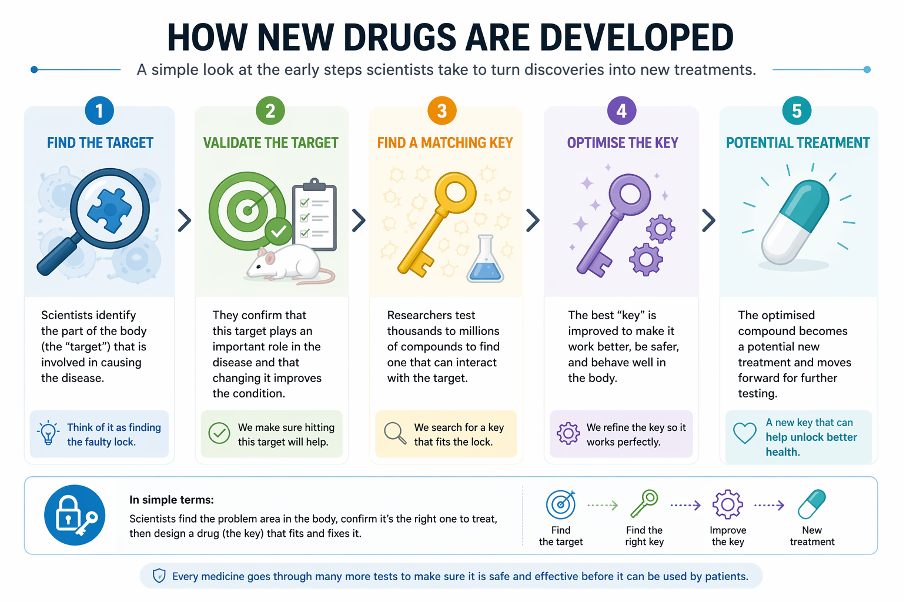
Finding the target (Target Identification)
During this stage, scientists try to identify a specific “target” in the body that is linked to the disease. This target could be something like a gene, protein or enzyme that plays an important role in causing or worsening the condition.
Confirming the target (Target Validation)
Once a target is found, researchers study in detail to understand:
- What it does in the body
- How it contributes to the disease
The goal is to find a way to design a treatment, such as a new drug that can block or fix this target, helping to slow down or stop the disease.
Before a new drug can be developed, scientists first need to find the right place in the body to target – also known as target identification and validation.
Scientists (or researchers) need to confirm that the target is the right one to focus on. They do this by:
- Studying how the target behaves in the body
- Testing what happens by blocking or changing the target
- Running experiments in the lab and sometimes in specially designed animal models
If changing the target improves the disease, it suggests that it could be useful for developing a new treatment.
This is an important step because it ensures that:
- The drug is likely to work
- It will be safe to test further
- It addresses a real medical need
It also helps scientists design drugs that can attach strongly to the target and produce an obvious effect in the body.
Lead identification and Optimisation
Once the right target is confirmed, the next step is to find a substance that can interact with it.
Finding a “lead” molecule
Scientists test large numbers of chemical compounds – sometimes thousands or even millions – to find one that has the desired effect on the target.
Any compound showing promise is called a “lead” or “hit” molecule.
Improving the lead (Optimisation)
After a lead is found, it is carefully improved to make it more suitable as a medicine.
Scientists adjust its properties to:
- Make it work better
- Improve safety
- Help the body absorb ad use it properly
This process involves repeated testing and refinement until the compound becomes a strong candidate for further development.
In simple terms
- First, scientists find the right “problem spot” in the body – the target
- Then, they confirm it’s the right one to treat
- Next, they search for a substance that can affect it
- Finally, they improve the substance to turn it into a potential medicine
The “Target Practice” Analogy
Think of developing a drug as hitting a bullseye
- The target = the bullseye
- The drug = the arrow
Discovery process:
- Find the right bullseye to aim at
- Make sure hitting it will actually help
- Test many arrows to see which one gets the closest
- Adjust the best arrow until it hits perfectly