When we hear about clinical trials for new medicines, many people assume the first tests are carried out in patients who actually have the disease. Surprisingly, that’s not always the case.
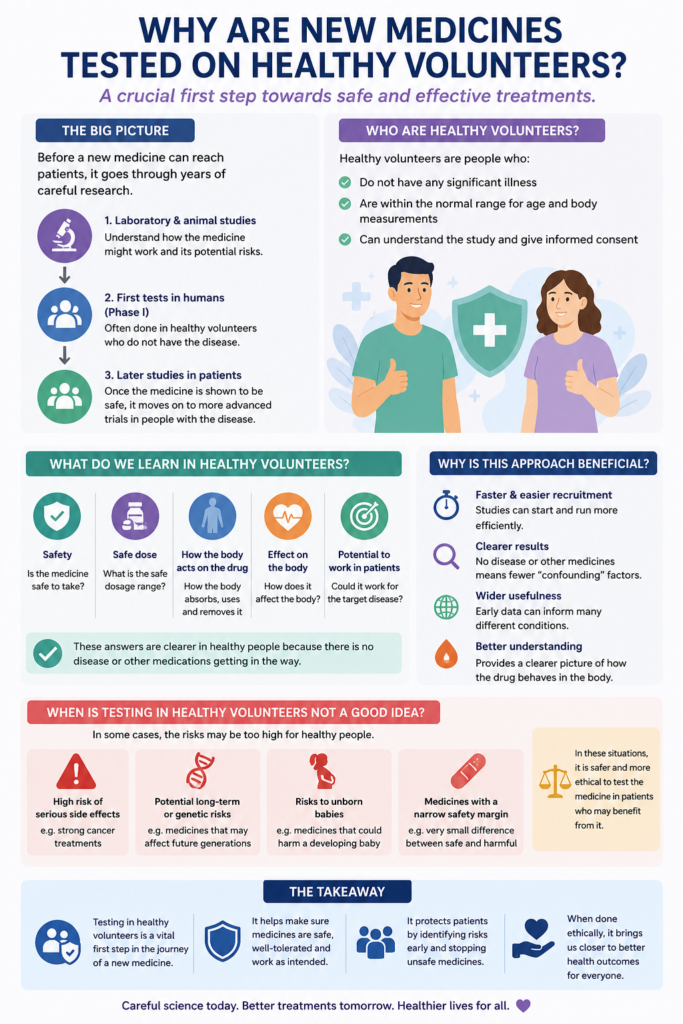
Before a medicine ever reaches the pharmacy shelves, it goes through years of research and safety checks. Scientists first study and test the drug in laboratories and through animal testing to understand how it might behave in the body. Only after these early stages can testing in humans begin.
The very first stage of human testing involves healthy volunteers – people who do not have the illness the medicine is designed to treat.
This may seem strange. Why give a drug to someone who isn’t sick?
The reason is simple: researchers need to understand how the medicine behaves in the human body without other health conditions interfering with the results.
Testing in healthy volunteers helps researchers answer important questions such as:
Is the medicine safe?
What does can people safely take
Does the body absorb and remove the medicine properly?
Are there side effects?
How does the medicine affect the body?
Researchers can get clearer and more reliable information during these early stages because the healthy volunteers are not taking multiple medication or dealing with serious illnesses.
However, testing in healthy volunteers is not always appropriate.
Some medicines carry higher risks or may cause serious side effects. In these situations, it would be unethical to expose healthy people to unnecessary danger. Instead, the medicine may be tested directly in patients who could potentially benefit from it.
This is especially true for treatments involving the use of cancer drugs, where risks an outweigh the benefits for someone who is otherwise healthy.
Essentially, testing new medicines in healthy volunteers plays a vital role in medical progress. It allows researchers to identify promising treatments early, stop unsafe medicines before they progress further, and protect future patients from unnecessary harm.
Every medicine we use today, once passed through this careful process – called a phase I clinical trial – before reaching the public.
Long before I ever imagined becoming a dentist, my earliest memory of dentistry involved a stubborn baby tooth hanging on by what felt like a single thread.
Most parents would have handled the situation themselves with the classic “quick yank.” But apparently, as a child, I had a reputation. Crying wasn’t just something I did – it was a full-time hobby. According to family stories, it wasn’t the crying itself that exhausted everyone…it was how long it lasted.
So, my parents wisely outsourced the task to the dentist.
I remember very little about the visit itself. My parents cleverly avoided telling me the real reason for the trip, so I happily tagged along, convinced I was simply enjoying a special outing with them. With four siblings, alone time with both parents was precious.
The fact that I barely remember the procedure – and nobody recalls hours of dramatic crying afterwards – probably means the dentist handled it quickly, gently, and painlessly.
But my most vivid childhood memory of the dentist wasn’t my own appointment. It was my younger sister’s.
The Fear of the Dental Chair
My sister had – and still has – a sweet tooth. After weeks of avoiding treatment for a painful toothache, the inevitable finally happened: a trip to the dentist.
Unlike my experience, she knew exactly where she was going.
By then, she had already absorbed all the terrifying myths and horror stories surrounding dentistry. The result was twenty unforgettable minutes of watching her crouch in the corner of the surgery, refusing to sit in the chair.
Eventually, after endless persuasion and the promise of sweets after the appointment (the exact cause of the current problem), she climbed into the chair.
That moment stayed with me because it perfectly captured something many dentists face daily: fear.
Why are people so Afraid of Dentists?
Let’s be honest – dentistry doesn’t exactly have the best reputation.
For many people, dental anxiety comes form unpleasant experiences, exaggerated stories, or scenes from movies that make dental appointments look like torture.
As dentists, one of our first tasks is often reassuring the patient. Before any treatment begins, we spend time helping patients relax and feel safe.
One phrase I hear often is:
“I hate dentists.”
Surprisingly, this is usually said by new patients meeting the dentist for the first time and I can’t help finding humour in this. Imagine saying that to a heart surgeon holding a scalpel moments before surgery. Bold strategy.
Still, fear is a human emotion and understanding people in dentistry is just as important as understanding teeth.
Dentists are much more than” Tooth Doctors”
I’ve always loved medicine.
Ironically, when I first gained admission to study dentistry, I felt unsure if I had made the right choice. Like many people, I thought dentistry existed separately from medicine.
I couldn’t have been more wrong.
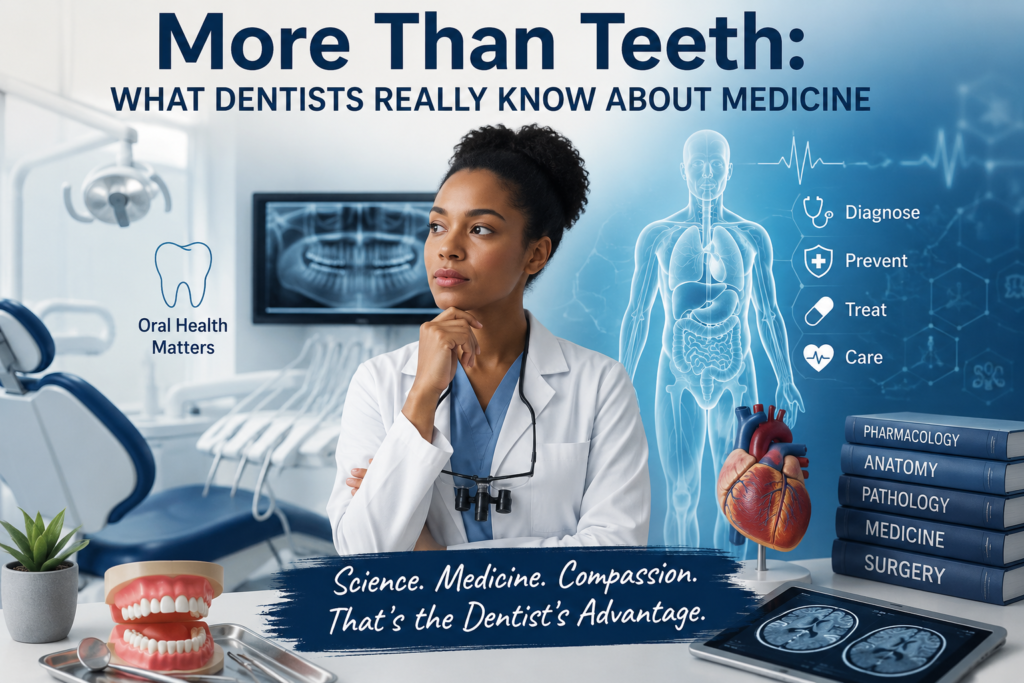
Very quickly, I realised dentistry sits deeply within the world of medicine and life sciences. During my undergraduate days, it genuinely felt like studying two degrees at the same time.
What surprises me today is how many people – including recruiters in healthcare and the pharmaceutical industry – don’t realise this.
I’ve lost count of how many interviews I’ve had, began with:
“How does dentistry relate to this role?”
Or the puzzled reaction from past colleagues when they discover my background.
One former colleague was genuinely shocked when I mentioned I was a dentist working in regulatory affairs. His response was “that’s a first!”
What most people don’t know about Dentistry
Dentistry is so much more than fillings and taking teeth out – or replacing lost teeth.
Yes, we improve smiles, relieve pain and restore function. But every dental degree comes with years of intense medical and scientific training.
To become a dentist, we study many subjects which include:
Anatomy
Biochemistry
Physiology
Pathology
Pharmacology
Medical microbiology
Medicine
Surgery
We must complete hospital rotations, examine patients, diagnose diseases and understand systemic conditions – much like medical doctors do.
Then alongside all that, we master the practical and technical side of dentistry.
It’s demanding, multidisciplinary, and incredibly broad.
The Unseen Hats Dentists Wear
Psychologists
Reading body language before a patient even sits down.
Scientists
Because science is the foundation of every clinical decision.
Surgeons
The degree is called Bachelor of Dental Surgery for a reason
Pharmacologists
Understanding medications, drug-drug interactions, contraindications (when to avoid certain medications), and safe prescribing.
Medical Writers
Documenting detailed clinical notes and referrals with precision.
Communicators
Working closely with patients, nurses, specialists and healthcare teams.
Dentistry: An often Misunderstood Profession
In my opinion, dentistry is a commonly misunderstood profession – even within healthcare itself.
Dentists are highly adaptable professionals with strong scientific, clinical, technical, and communication skills. The profession demands precision, emotional intelligence, medical knowledge, and the ability to stay calm under pressure.
So, when someone asks: “what do dentists know about medicine?”, the answer is simple: quite a lot, and more than people realise.
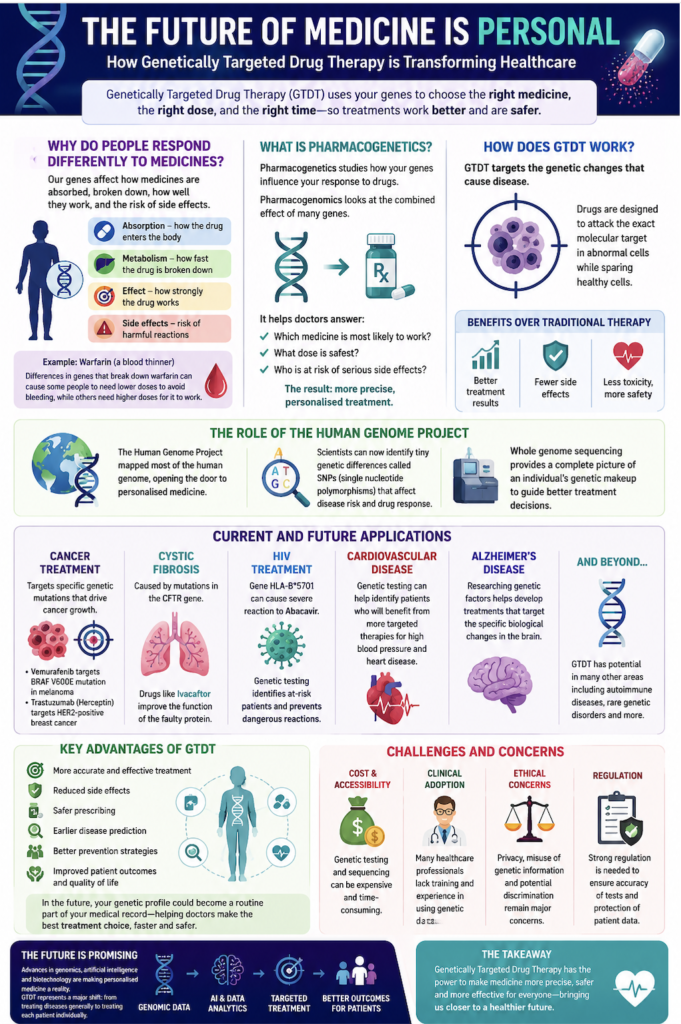
Modern medicine is moving towards a future where treatments are designed specifically for each person. This approach is called Genetically Targeted Drug Therapy (GTDT), which is precision medicine. Instead of giving the same medicine to everyone with the same illness, doctors can use a person’s genetic information to choose the safest and most effective treatment.
Why do people respond differently to medicines?
Not everyone reacts to medicines in the same way. A drug that works well for one person may not work well for another, or may even cause harmful side effects.
One major reason for this is genetic variation. Our genes affect:
How medicines are absorbed in the body
How quickly drugs are broken down
How strongly medicines work
Whether side effects occur
What is Pharmacogenetics?
Pharmacogenetics studies how a person’s genes influence their response to drugs. A related field, pharmacogenomics, looks at the combined effect of many genes on treatment outcomes.
These two fields help doctors answer important questions such as:
Which medicine is most likely to work?
What dose is safest?
Which patients are at risk of severe side effects?
This allows treatment to be more personalised and precise.
How does Genetically Targeted Drug Therapy work?
GTDT focuses on the genetic causes of diseases and targets them directly. Instead of treating only symptoms, these therapies aim to interfere with the exact molecular problem causing the illness.
This is especially important in diseases like cancer, where sudden changes in genes can cause the growth of abnormal cells.
Unlike traditional chemotherapy, damages healthy cells as well as cancer cells, targeted therapies are designed to attack only the abnormal cells. This often means:
Better treatment results
Fewer side effects
Reduced toxicity
The Role of the Human Genome Project
The development of GTDT became possible after major advances in genetics, especially the Human Genome Project,which successfully mapped most of the human genome.
Scientists can now identify tiny genetic differences called single nucleotide polymorphisms (SNPs). These variations can affect how diseases develop and how patients respond to drugs.
Modern technologies such as whole genome sequencing can analyse a person’scomplete genetic makeup, helping doctors predict treatment responses accurately.
Current and Future Applications
Cancer Treatment
A major application of GTDT is in cancer treatment. Certain cancers cause specific changes in the genetic material (mutations) that can be targeted with specialised drugs.
For example:
Vemurafenib targets a mutation called BRAF V600E in melanoma.
Trastuzumab (Herceptin) targets HER2- positive breast cancer
These treatments offer a more targeted approach to treatment with fewer side effects compared to traditional therapy.
Cystic Fibrosis
Mutations of the CTFR gene causes cystic fibrosis. Certain drugs like Ivacaftor are designed to improve the function of the faulty protein caused by the mutation.
HIV Treatment
Some patients carry a gene called HLA-B*570,which can cause a severe allergy to the HIV drug Abacavir. Genetic testing can identify these patients before treatment begins, preventing dangerous reactions.
Cardiovascular (heart) Disease
Genetic testing may also improve treatment for high blood pressure and heart disease by identifying patients who benefit from kore targeted therapies.
Alzheimer’s Disease
Researchers are studying the genetic factors involved in Alzheimer’s disease to develop treatments that target the specific biological changes occurring in the brain.
Advantages of GTDT
Compared with the conventional “one-size-fits all” medicine, GTDT offers several benefits:
More accurate and effective treatment
Reduced side effects
Safer prescribing
Earlier disease prediction
Better prevention strategies
Improved patient outcomes
In the future, a patient’s genetic profile could become a part of medical records, helping doctors choose the best treatment quickly and safely.
Challenges and Concerns
Although GTDT has huge potential, there are still challenges:
Cost and Accessibility
Genetic testing and genome sequencing can be expensive and time-consuming.
Clinical Adoption
Many healthcare professionals still lack training or experience in using genetic data in prescribing decisions.
Ethical Concerns
There are concerns about privacy, misuse of genetic information, and possible discrimination in offering long term treatment to patients based on genetic risks.
Regulation
Strict regulation is needed to ensure genetic testing is accurate and patient data is protected.
The Future of Prescription Medicine
The evidence strongly suggests that genetically targeted drug therapy will play a major role in the future of healthcare. Advances in genomics, artificial intelligence, and biotechnology are making personalised medicine increasingly possible.
Rather than relying on trial-and-error prescribing, future treatments may be selected based on each patient’s unique genetic makeup. This could lead to safer medicines, fewer adverse reactions, and better treatment success across many diseases.
GTDT represents a major shift in medicine – from treating diseases generally to treating each patient individually.
I’m Eki (Kiki) – a dentist, scientist and writer with a passion for creating engaging scientific content, particularly around innovations in drug discovery. I also enjoy exploring everyday issues and sharing thoughtful perspectives on how they shape the world around us.
From the Dental Chair to the World of Medicines: My Journey So Far.
If you had met me a few years ago, you would have found me in a dental clinic, focused on helping patients manage their oral health – one appointment at a time.
What I didn’t’t realise back then was how much these interactions would shape the path I’m on today.
Because beyond the routine check-ups and treatments, I started to notice something deeper: many of the conditions patients presented with, could have been prevented, with early intervention. Most of the treatments being offered were temporary fixes to chronic conditions with preventable causes.
One of such conditions is gum disease. It doesn’t sound serious, but it can quietly progress, and over time, lead to tooth loss. My first hand experience with these conditions, made me start asking questions – why are there still limited treatment options for some conditions? And, could we do more, earlier?
Curiosity turned into something more.
My curiosity led me back to studying and research. I obtained two master’s degrees (with distinctions) in Experimental Oral Pathology and Clinical Drug Development. With projects which involved working with antibodies to develop a clinical drug for gum disease, and the potential for nano carriers to be used in treating oral cancers, my fascination with the drug development process was heightened.
Before that, I saw treatments the way I think most people do: something your doctor prescribes. Something that already exists.
But behind every medicine is years of work, countless decisions, and a lot of uncertainty.
What most people don’t see.
Drug discovery is not the most visible part of healthcare, but it is an important one.
Every new treatment you hear about has gone through an incredibly detailed journey. There are moments of progress, but also setbacks, questions, and careful checks along the way.
And while that can make things seem slow from the outside, it’s all there for a reason: patient safety.
Why I care so much about this.
Overtime, my focus has grown beyond dentistry into a wider interest in how we treat serious diseases – especially those where better options are still urgently needed.
What drives me is simple: improving patient access to better treatments – without compromising on safety and trust.
It’s a difficult balance, but one worth striving for.
Why I’ve started this blog.
I wanted to create a space where I can share all that I have learnt, and I am still learning. All without the unnecessary complexity.
Just honest insights about drug discovery, innovative medicines and related medical conditions, and the questions we should all be asking. I’ll also be sharing my thoughts and perspectives on everyday issues, and how they affect us as human beings living in a constantly evolving world!
If you’ve read this far, thank you! This is just the beginning, and I’m looking forward to sharing more along the way.